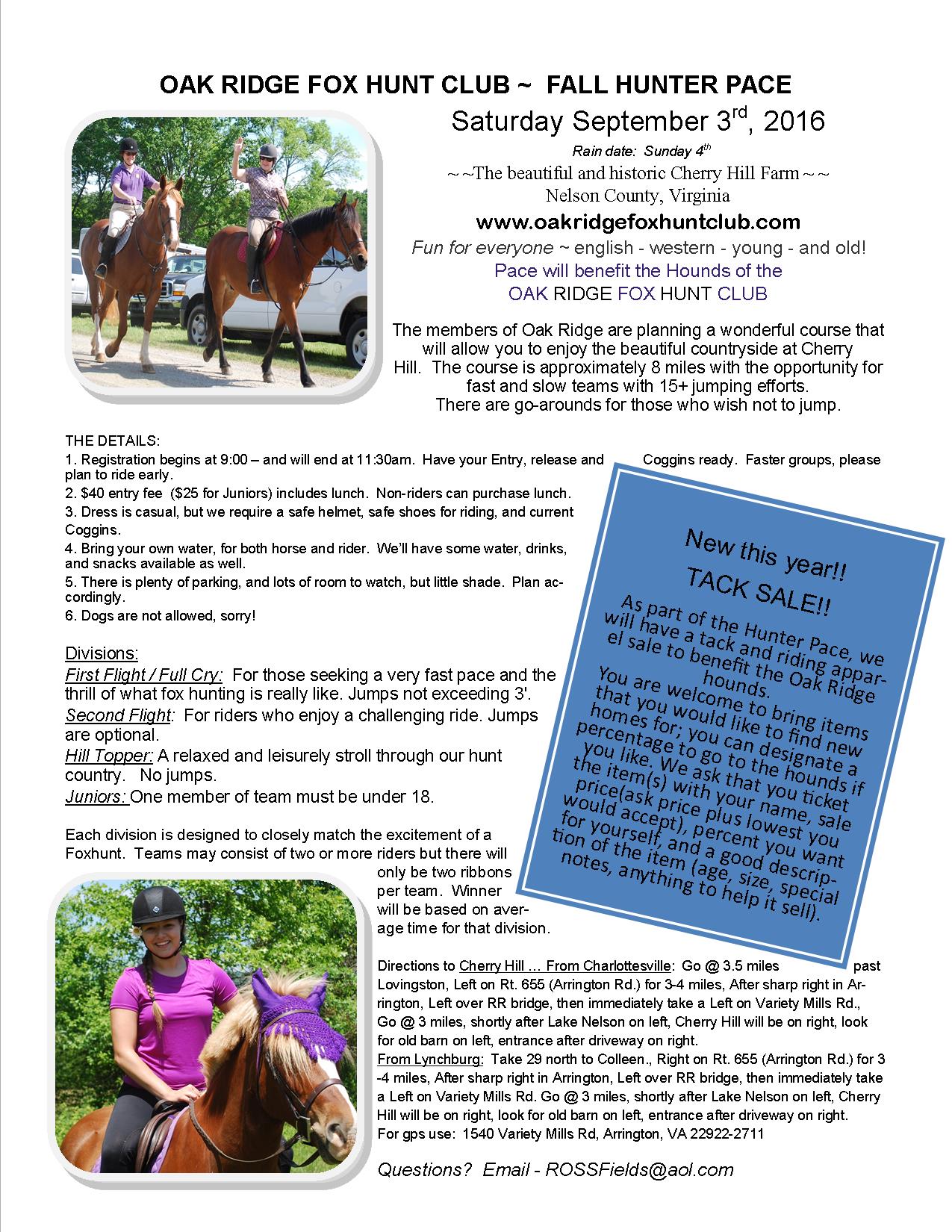
Fall Hunter Pace and Tack Sale
Image
Reply

ANOTHER DAY IN PARADISE
The second half of our season was the best I remember since 1981. 1993 also enjoyed some good spots but once we slid into December, 2015 the good days piled up, the foxes ran and ran plus they showed themselves. The hounds made me and hunt staff very proud.
Deer season ended January 3, 2016. Usually it takes a week or 10 days for foxes to give up sitting tight. Boom. On the very day the deer hunters trudged home, the foxes shot out of their dens.
Valentine’s Day proved especially memorable. Hounds have a 17 mile run! That was what I clocked in the hound Tahoe. The pack actually ran more miles than that as they flew to Durrettown, came back half way, returned to Durrettown, then using the top of the ridge, headed back to Tea Time, occasionally dipping off the ridge for another run. We could see some of it and hear all of it.
As we could not hunt Foxden that day, the field finally turned back because that’s where the fox headed and circled in there for a bit. Maria, Mary and Becky were hard put to keep up but they wisely stayed out on 611, going into the uplifts and ravines once beyond the Foxden, but hounds, by that time, were so far ahead there was no way whippers-in or huntsman could possibly catch them. As you know, this is quite difficult territory even on a slow day.
Maria held up by Jim Klemick’s 611 gate and blew. Luckily, Tom Harvey drove to pick up mail and then into his property. He kindly opened the iron gates, and told the whippers in to go on in which they did. By now the mercury wasn’t creeping upward, it was starting to slip down. You could really feel it; Maria blew and blew as she returned to Tom’s open gate. It’s difficult for any hound to surrender a scorching line.
They began to trickle in. I thought they’d need oxygen masks but they looked good. Thank God for proper conditioning.
Tucker lagged behind. I sat by the mail boxes and waited. Half an hour later she walked down 611, a bit fatigued. I opened up the back of the Tahoe then realized I couldn’t lift her in thanks to my broken hip. As luck would have it, my wonderful neighbor, Ella Sue Parker, drove up 611 to pick up her mail. Seeing my predicament she hopped out of her car, lifted up Tuckers back end while I steadied the front. In she went. Ella Sue and I had a good laugh.
How many women do you know who would come home, nicely put together, get out and lift up a hound to help your neighbor? We have really good people in Nelson County and wonderfully understanding neighbors.
Tucker arrived at the kennels as John and Toot were wrapping up for the night. She was very happy to go inside as it was now cold. Lots of tail wagging. The miracle was no cut pads, no barb wire slashes. Some food, water and warmth and everyone fell asleep.
That is the longest hunt Oak Ridge has ever had in terms of miles covered and the longest one I have seen period.
Each succeeding hunt provided good runs, multiple views, all reds. The music echoed adding to the excitement.
February 20 we had a joint meet with Farmington at Reynolds Cowles, DVM and Evie, his wife, who could organize anything. Their hounds were in good flesh, drew so well. Footing, slick in parts, was mostly good, a little gushy in other parts it okay. Our visitors from Rombout Hunt went out with us Friday the 19th, then Farmington, then us again. Farmington spoiled everyone with their breakfast and good company. I particularly enjoyed watching the huntsman draw. I have not had the pleasure of watching him, he came last year (I think, time flies so). He made such good use of the territory, has an upbeat personality and the hounds hunted well for him. Good for Farmington.
As an aside, we have never had a blank day on our Wednesday afternoon hunts. Some slow days but not this season. Long runs, hard runs with people turning back for home once the sun sets and the temperature creeps into your bones.
The oddity was we had two 80°F days and hounds still pushed out foxes for good runs. That’s just unbelievable.
CLOSING HUNT – March 2, 2016
Dire predictions of snow and rain worried a few people but most foxhunters know that’s the best weather and indeed it were. The first cast, 10 AM, witnessed glowering skies, mercury in the low 40s. Raw but not bitter, a slight westerly wind did promise good scenting.
Hounds, cast, trotted up the hill, struck and didn’t stop screaming and running until 1:30 PM.
How to describe this spectacular day? Well imprisoned in the Tahoe, I listened intently at the first strike. Rode around to the back of that ridge and thought I heard the packs split. Sure sounded like they were on two foxes. The group closer to me circled twice then dipped down to the feeder box were Jimmy Carter’s, Mrs. Woods’ and my territory join. From there they took off again and the sound rolled away towards the south. I waited and in about 15 minutes the hounds came roaring back and were down below where the creek meanders. That creek, while not deep, has a good flow even in summer.
Sitting beside the ever diminishing hay bales, which we put out for the foxes to squeeze between if need be, two hounds began to climb the hill. Next, more followed. I should add here that what really squeezes between those old hay bales are mice and rabbits. Hounds ignored them, shot by me and dipped to the other side of the farm road. Then Maria blew and back they hurried down again to where there used to be a tiny wooden bridge over the creek. Floods have taken care of that and to the right of it is a nice little ford, sometimes muddy but always passable. Again, as I couldn’t see it, sounded like hounds were all together, now the music increased in volume.
So I backed out and drove down to the Standard Oil sign, beyond and parked up by the other hay bales with the two fox dens. Obviously, these foxes did not wish to waste money on gas. Why not just live across the street from the supermarket?
A line of hounds appeared on the top of Mrs. Woods’ high meadow, turned down into the pines and all in a line, noses down, speaking; they ran, trotted at times, turned back and snaked through the cutover. This was textbook stuff, hounds nearly nose to tail. They turned, headed back and finally wound up with me, then back down to the other creek which is a little bitty feeder creek, more room to fan out so they did. What beautiful work. The entire day saw them either in a line or running together if there was space. It truly was right out of a Nineteenth Century fox hunting book.
People began to return to the trailers in small groups. No wonder, they’ve been running since 10 AM. I did not see or hear one check. I heard slower going at times but the music was continuous.
We flushed out the three fox, maybe four and I think one was put to ground early and finally one was put to ground over on Jim Klemick’s. (This is my conclusion via hearing).
Maria headed for home but hounds struck again in the cornfield. Sounded like it for by now I was sitting at the lower barn, the shed row barn. And darn if they didn’t go away, heading north. The only route for a vehicle is to go up on 611. I did. I could still hear them so I paused at the pretty new house which is being built since we do have a fox that crosses there regularly. But no one came up through the ravine.
I heard them turn again back towards the south. I couldn’t hear how that happened but later learned that the entire pack headed for Jim’s most northern bridge. Thank God, Dee Phillips blasted up there and turned them back because 151 is close by. But turn they did heading back to the cornfield.
Finally, with efforts from staff, hounds gave up the line and walked out, hardly the worse for wear, I might add, and ambled out to the arena. Thence to the kennels. This is not only the best closing hunt we have ever had, it’s one of the best hunts we have ever had.
It’s a terrible thing to brag but our pack was super, the youngsters stepped right up to the plate. All worked as though of one mind. I was beside myself with excitement.
Congratulations to Maria, Dee, Becky Birnbaum, Candice and Sonia. (Did I forget anyone else who whipped-in that day?) As always, special thanks to John and Toot for their hard work and care. My happiest days are with “the boys” at the kennels or walking along with hounds joined by Maria, Sonia and Mary, when she can make it. In the past, Stuart was with us and I would like to think he was with us Sunday, March 20. He would have been so proud.
The kids get a month to six weeks off. Fortunately no one is foot sore, tore up or has burned through a lot of weight. We have a few hounds of high metabolism but even they look presentable and usually by season’s end they begin to have the “Tijuana look” as Judy Pastore would say. So whatever needs to be done at the kennels, we start now.
It’s a joy to stop by and chat with the hounds who exhibit such curiosity about what one is doing. I think they all know how well they hunted this season and they’re probably blabbing among themselves.
“Well, you know I pushed out the first fox.” Mustard might say.
“Oh, dream on, girl. You know it was Metal.” Magnolia, her sister, will sniff.
On and on, they chatter, reliving the season. Kind of like us.
RMB
HOUNDS AND THEIR FRIENDS
Priscilla Friedberg and Jim Finn still send a huge box of hound cookies each month. Hounds love their cookies. We have to hide them in a safe place or all would be gone in the batting of an eye.
All the M’s have been outstanding in their second full season. They are also beautiful and beautiful movers, too.
Lilac, old Bywater’s blood, is not exactly beautiful but she possesses a rangy body and can cover distances with ease. You can go to the bank on this hound and all of staff loves and respects her. She’s easy to pick out in the pack and gives good voice, too.
I know it’s harder for field members to identify hounds by voice and staff can’t always do it either, but some hounds are distinctive, high piping trills, others have basso profondos. We’ve got the full chorus and that’s quite helpful. If all sounded the same it would be harder for us and you know it’s hard enough during cubbing when you can’t see much and the leaves on the trees soak up the sound.
A few hounds will be retired with honor. As most of you know, I can find homes for some but most I use during summer hound walks and our “games” which are really lessons. Those older hounds are dipped in gold.
We have some bad girls. You can’t hunt Lupine and Luster together. They behave like two high school sisters who have gotten hold of Mother’s credit card. Throw Mustard in there and you have a hound secret sorority. I’m surprised our little divas haven’t asked for hound collars studded with rhinestones.
The boys aren’t much for rhinestones nor are they naughty but there are times when you work to get them to focus, it isn’t even a girl coming into heat before humans know it. That we can understand. The males of all the higher vertebrates are just undone by bombshells. No, its things like butterflies, a large passing cloud which casts a big shadow or, for whatever reason, an especially interesting stick. This is the reason we don’t hunt the boys by themselves. We have to put some girls in there to push them on which we tried to do, too. Once the weather turns, the temperature drops, scent intensifies, they do a good job. The other thing about the voices, they are uncommonly sweet.
Having said that, Cortez hunts like a gyp. Total focus, focus like Piper.
While one can generalize about the difference between males and females in the pack, they truly are individuals to which those of you who remember Vandal can attest. I have no idea where the hound learned to love beer cans but my suspicions are aroused by some of you in the field. It’s too much fun, isn’t it?
A CORINTHIAN CLASS
If you subscribe to the “Chronicle of the Horse”, once a month they include a glossy magazine edition, “Untacked”. This March/April 2016 edition is excellent. On page 50 begins a section on foxhunting fashion. It’s worth a look. The turnout in there starts in the 1950s. Not every fashion changes included in a photo. Most especially the 1970s, there is a photo of a huntsman in a coat with properly longer cut to the coat. Jackets began to creep up in the 70s and the 1980s photo shows same, but that 70’s huntsman would have none of it. Fortunately, that fad, short flaps, is dying out, mostly for practical reasons, a longer flat flap keeps you more protected and warmer.
I mention this because, as many of you know, I care about turnout. And I know all these nasty little details like hammerhead spurs are more correct than Prince of Wales which came into fashion when The Prince of Wales, in the 1930s, began wearing a shorter spur with a nub. It looks just fine, but if I were judging a Corinthian class and two people were tied, I would pin first the one with the older type of spurs.
In general, I favor what has stood the test of time. Breeches. Now we wear them with leather knee patches sometimes even leather butt patches. Is that helpful? Yes. Is it 100% proper? Well, maybe it’s okay in the hunt field but not in a Corinthian class. If you do have patches they will be of the same color and fabric as your breeches.
My argument to anyone who wants to make a change is, “Can you find it in a 19th-century print?” I always lean toward the tried and the true.
The two biggest changes I have seen are in headgear and coat color, almost uniformly black. I still believe you wear a derby or a tophat unless you are staff and then you wear the velvet cap. However, I have gone to other hunts where the Master insisted, ever so nicely, that I not wear my derby.
But do I seethe when you show up in my hunt field with a bubble head? No. It’s your head. But you can’t dream of wearing such a thing in a Corinthian class, where even the sandwich in your sandwich case is inspected. (No crust. White bread. Sliced chicken. No butter or mayo.)
Also, men carry flasks; ladies carry a square case with their sandwich and a rather dwarfed flask. Ladies may use sherry, gentlemen something more robust. Now in the hunt field you can put whatever you want in that flask, but not in class.
Veils. Depends on the attire. In the very old days, those of my great-grandmother, veils were attached to derbies and tophats and ladies could roll them up whenever they felt it would have the most devastating effect on a gentleman. Now you rarely see them except sometimes with sidesaddle turnout. Is there anything more graceful, more divinely feminine, then a lady riding sidesaddle? God bless any woman who does so and as most of you know, a woman is tight in the tack.
The reason I’m nattering on about this is the Corinthian class is our history, our remembering our dress traditions, thus honoring all those who’ve gone before. It’s such a lovely class and not seen as much these days at hunt shows as I would wish. As an aside: If your hunt has livery, you are allowed to ride in same in a Corinthian class. We do have livery, light gray.
In England a few more hunts ride in livery than over here, but I think there are some in North America. Masters don’t insist you ride in livery. Once you acquire your colors, you are allowed to hunt in livery, always considered an honor. You may also ride in navy blue which is quite smart. Many hunts allow green, such as one wears hunting beagles, but you wouldn’t wear green in a Corinthian class unless that was your hunts livery.
As for our gray, well, I do love it but I know one must have the coat fitted properly by a tailor or seamstress. You can’t buy livery off the rack. We have a few people who ride in our gray and they look smashing. When Mary Shriver and Kristin Ford rode in gray for the pair’s class at The Warrenton Horse Show, they did cause an appreciative murmur. The fact that they rode so well didn’t hurt either.
There you have it. A brief overview. I haven’t addressed tack or garters, etc. but that’s another issue. Am I asked to judge Corinthian classes? NO. Everyone knows I am ruthless. I am asked sometimes to judge hunters in the field which I enjoy doing. Do I observe you in our hunt field? Indeed, I do and I thank you all for clean tack and a tidy appearance. Pulling yourself and your horse together on a dark, cold winter morning is no mean feat. Well done.
P.S. I have never seen a turnout class (it would not be called Corinthian) where ratcatcher is judged. As the rider has more range of personal choice I think a ratcatcher class would be great fun.
BE TRUE TO YOUR SCHOOL
By now many of you have ridden over the seven sisters or seen the seven jumps, each one named after a seven sister, Smith, Mount Holyoke, Bryn Mawr, Radcliffe, etc. Each sign is in the colors of the school. Sara Bateman, ex-MFH has given them as a gift to the hunt.
If you would like a jump named for your college, university, or high school, $100 will buy two signs, one for each side. As many of you have attended the same university, you can go in together. Based on the number of UVA and Tech graduates alone, we could name many jumps. The purpose of this is twofold: to have some giggles and raise some money. To be able to identify jumps, should we need to get to them quickly, is an advantage.
We also encourage you to build new jumps if you so desire. We could use a bank jump, another tiger trap and so forth. And what’s prettier than a stone jump built out of limestone or slump brick? The fieldstone is okay but hard to fit together and falls down more easily. A two foot stone jump with a thick tree trunk or telephone pole on top is very pretty and inviting. We used to be able to pick up telephone poles and electrical poles for a few dollars, but they won’t sell them to the public anymore. Also, railroad ties, zigzag jumps, are really easy to build and give a rider a few choices.
If you want to name a jump, I will get the signs made. You will need to give me your school colors but don’t give me the check. Send that on to David. My cats will try to cash the checks or eat them.
For those of you who wish to build a jump or have us do it, identify where you want it, walk the area with us to make sure we, and you, if you’re building, set it correctly. It’s less money if you build it and scrounge the materials, but we will do it and bill you for the lumber, stone, etc. Of course, natural jumps, with which our territory abounds looks tidy and good. Also, not much cash outlay. You need to cut up some fallen hardwood and drag to site or have us do it for a small addition to the $100 for your sign. Small as in $20 for hounds. My experience, and I bet it is yours, too, is horses take a solid jump seriously. However we do have a few airy ones and the reason for that is we want Oak Ridge members and horses to ride over everything. This way if you are at another hunt, say with many stone jumps which they have more north of here, you and your horse will be fine.
We’d like to start this at the home fixture but over time, if our land owners allow it, we would build more jumps there. Some fixtures this is easy, others, not so much, but we can always ask.
What about coops? They are easy to put up which is why you see so many of them throughout the hunt world. We have them at various heights. I’m not opposed to coops but my sense is, if you jump what we have here, you’ll be fine elsewhere. My hope is to expose you to a variety, but anyone who wants to build the coop, go for it.
New York University’s colors are purple and white. I haven’t selected my jump yet but I will. Waiting for you all to join in.
Here’s another question: should we have a small sign, blank on the opposite bottom side of the jump or discreetly nailed to a tree? Should you encounter difficulty and a dismount at said jump, your name will be painted on that sign. Cruel? Well, not really cruel, but I have found the potential for humiliation a spur to focus. The worst part of it is this isn’t like a bottle and a poem. Your name (and eventually mine somewhere) will be inscribed for hunting eternity.
Well, once the hip is fixed, I need to work hard on my riding skills. Do you want someone saying about a jump, “Oh yeah, Charlotte’s jump?” (We don’t have a Charlotte but someday we will. Used the name so no one thinks I’m picking on you. I will pick on you, but not at this moment.) Of course, you don’t want your name attached in people’s minds to a jump. This really is motivation to improve.
Oak Ridge enjoys good riders. Our first flight often winds up being first flight elsewhere and at the end of the hunt; Oak Ridge is all that’s left. Still, we can all improve. Think on this but do come through for your school. We will have such fun with this, plus will learn where we all studied. I’m going to do one for my high school, too.
Up and Over (Really)
P.S. If anyone was born in another country, we can make a sign for your birth nation. And by the way, we are glad you are here.
A READING LIST
Years ago, Suzanne Hogg asked me to put together a reading list for fox hunters. Perhaps one of you can start this project and I can add to it, but I haven’t the time. I do have a good library and for me everything starts with Arrian but many of you might not feel the same. I am sure though that all of you would agree, “Memoirs of a Foxhunting Man” by Siegfried Sasson is a must. But do consider this if so inclined.
PENLAN STATION
At our last hunt there, Bill Yancey and Neil Stout, Bill’s son-in-law, told us of future plans for that wonderful property. Neil also cornered Libby, a pug puppy he bought for his wife. Once on the ground Libby took over. Lynn Lloyd hunts with her pug in the pack. If the dog gets tired, she picks her up. They are tough dogs and utterly beguiling… as are Bill and Neil
STEPPING UP
Sandra Dawson led first flight, when asked, and Wayne Dawson whipped-in. Meghan Custer worked with Becky Birnbaum regarding with whipping-in also. Thanks to all.
As I often miss what’s going on in the field, my focus being the hounds, I may have missed thanking someone. Hopefully Bob and Sue will correct this oversight. It is gratifying to see members work to learn their duties as none of them are easy.
A SILVER LINING
A benefit of not being able to ride, following the hunts in the hound Tahoe (a gift from Donna Gaerttner), I’ve seen things I would miss otherwise. This will help me improve territory for next season. Rest on your laurels and you get a fat ass. We can always do better.
Every year differs from every other which makes hunting interesting. Our season started as it always does with cubbing right after Labor Day. Conditions remained warm and relatively dry for weeks. We cast hounds early enough to benefit a bit from dew.
Entering young hounds in less-than-perfect conditions actually helps. If youngsters only know great scent and long runs when less-than-perfect conditions occur, they can be at a loss. Of course, the older hounds help as they keep pushing.
The weather that’s impossible for everyone is drought. While we did have dryness we did not have a drought, so our hounds would pick up the line, run it for 10 or 15 minutes and lose it. They kept trying and staff was happy to see the youngsters pick up that work ethic.
Opening Hunt was as always. However, the black fox that lives on the eastern side of the cistern, down there where the creek is deep, made an appearance and just as quickly ducked back into the rough. We used to have trails in there and, with luck, we can again open them this summer. The creek flows behind the old beef barns and provide some moisture, no matter what. I have walked that area as recently as last spring so I know where some of the dens are, quite cleverly hidden. He’s a smarty.
November’s temperatures bounced around. This combined with deer season made for tough going but hounds pushed out foxes. Nothing lasted for long.
December defied description. The Mercury read 77° F at my house on Christmas Eve and about the same for Christmas. I remember a similar experience once in the nineties. God bless the hounds. They went out wearing their winter coats and tried.
Then like magic everything changed. Deer season stopped as the weather turned more wintry. We enjoyed a few good runs. The deer season ended, as it always does, the firstSaturday after New Year’s. Usually it takes foxes about a week to no longer sit tight.
As it happened, we put in a special Wednesday hunt on January 6, pretty cold and overcast. No one showed up but Jacque and it was the run of the season! Maria cast hounds, they hit within 15 minutes up behind The Arena and they ran, they flew, until sunset, when it became both dark and bitter. She had a bit of coaxing to do to bring them back to the horn, but good kids that they are, they did come. And since that afternoon hunt, the season has really picked up. Hounds have locked onto visiting dog foxes so the runs have been boisterous and long. Footing, bad in spots, is okay.
That is about to change. We’ve had Jonas. Naming the storms makes them easier to remember, I guess, and this was a whopper. Tucked up in the kennels, lots of straw to burrow into, all was well. Some of the older hounds liked their condos. In winter we put on their cold-weather doors, jam them full of straw and they preferred them. Well, what a surprise when hounds looked at all that snow about two and a half feet with bigger drifts.
Once the storm passed, they ventured out of the kennels and condos. There’s always some joker who rolls around, the canine version of snow angels. Given the depth of the snow they can’t run, but they can throw snow on one another. What a happy crew.
I have no idea when we will hunt again because the days, according to my weather app, will be high 30s, 40s, and the nights will plunge into the teens. That means melting and ice. As we’ve had so much snow it won’t disappear rapidly but there will be so much ice in the mornings. Even if you have studs in your horse’s shoes, it’s dicey, plus we have no idea of the condition in the mornings of the public roads. As to the roads on our fixtures, there’s no way we can remove the ice. So right now it doesn’t appear promising.
As soon as it’s reasonably safe for man and beast, we will go. Meanwhile, the foxes on the home fixture have plenty to eat. Some of our other fixtures have feeder boxes, some do not, but I expect those boxes need refills. Getting to them right now is impossible. Fortunately foxes are smart and good hunters. Still, I like to help them when times are harsh.
Have you noticed how thick and beautiful the coats are on our foxes? One of the reasons for this is our parasite control program. Once a month we mix some wormer in the kibble for them. Occasionally, we pour grease on the kibble, too. We used to be able to get restaurant grease but our source has dried up, so we purchase corn oil. They don’t need a lot, more like a healthy drizzle. The worming stops in March, usually mid-March, when the vixens are pregnant. Can’t give any wormer as you’ll kill the babies. So we start worming again in September, when the kits are about half-grown and all is well.
But our maintenance program is one of the reasons you see such healthy foxes. We have got to figure out a way to manage our far away fixtures on a regular basis. Of course you can hunt foxes without such a program, but I really believe in taking care of our quarry. They provide us with such pleasure, let’s give them the best.
We do have one fox on Tea Time Farm who has become a real smart ass, forgive the slight profanity. This fellow lives somewhere near the stick and ball field. I like to cruise the farm at dusk, and occasionally right after dawn, when the game moves about. Well, this guy is a medium-sized red. He walks in no hurry. Sometimes he will sit down and look at the car. When he’s satisfied that a large idiot is inside, he then moves along, beautiful brush much in evidence.
He may be the fellow hounds pick up south of The Arena, or just on the other side of the road behind the kennel, which goes down to the Jerusalem field. He knows every trick in the book.
With a bit of wandering off the actual hunting, that’s been our season to date.
OPENING HUNT
Yes, it was warm. It was the miracle of the fishes and the loaves, but the best part of Opening Hunt is I couldn’t go on, and after about 15 or 20 minutes, gave the horn to Maria Johnson. I’d called her the night before stating I felt I wouldn’t last, thanks to the ever increasing pain in my broken hip.
Maria, who has been working with hounds and doing wonderfully well, still had never hunted hounds with that many people behind her. Well, she did like a champ and she’s carried the rest of the season.
This thrills me, and hounds are happy, too. Once I’m put back together, we will work out a schedule next season so she can keep up her skills. Good for both of us and this is the first time in 23 years when I could take a hunt day off. Naturally I never wish to do so, but this does please my publisher.
Maria and I have even talked about taking a day or two each month and hunting in tandem which would be enormous fun, I think.
She’s done a great job and do tell her. The whippers-in adjusted quickly and really like whipping-in to her. Oak Ridge is very fortunate.
EMERT
Yes, Emert is back and better than ever! Hounds hunted there for the first time in years on Friday, January 15 and pushed a fox out on the west side of the paved road and off they went. The music was lovely.
With a bit of care here and there, this will be an outstanding fixture.
PENLAN STATION
We are becoming more efficient here as we know it better and better. As topography goes this is our most generous fixture. The bears think so, too.
We are eager to keep hunting there, but Sunday, January 24th, we were snowed out.
Emert and Penlan Station are on the south side of the James River in Buckingham County, which is our territory. The soil is different than north of the James. Fortunately, our hounds are so versatile, more so than we humans. We keep learning. What we are learning is how much we like Buckingham County.
TECHNICAL TIDBIT
Our territory encompasses rolling hills, deep ravines, some wide, some narrow and the last remnant of the eastern ridge of the Blue Ridge Mountains, which is Ennis Mountain, to the east of State Road 611. The true last gasp of the chain is the Southwest Range, which is in Keswick’s territory.
The Rockfish River runs through Tea Time Farm, Rucker’s Run barrels through Oak Ridge and Cherry Hill, backed by Turner’s Ridge, sports a narrow but fast running creek, which ultimately empties into the Upper James, which you can see from the top of Turner’s Ridge.
The territories on the south side of the James have a lovely roll to them, but the steep, steep ravines are gone, plus you are that much further from the Blue Ridge Mountains, which are almost in the backyard of Tea Time Farm.
For a huntsman and whippers-in this means the winds can really fool you. Hounds can be traveling along Miss Wood’s Creek and the slight wind is right in their faces, where overhead it is whistling in the opposite direction. Hunt staff has to keep adjusting, tacking as it were, to that wind, knowing the minute they come up on the high meadows, it’s a whole new game.
Then there are the wind devils. Of course, they can occur anywhere but there are spots on the home fixtures where even if there’s a two mph wind, you’ll get a wind devil. The fox knows them. The fox also knows where all the running cedar grows and s/he makes good use of it.
If you’re riding in the field, certainly you feel the wind. The huntsman must use it. You don’t want the wind at your hounds’ tails. Now you can’t always help this as you may need to get from A to C, so you push through the unfavorable wind direction. Ideally, you want the wind in hound noses. Sometimes crosswinds work well, too.
Actually, most huntsmen learn to use wind and a cubbing wind is vastly different than a February wind. It’s harder for the whippers-in. A whipper-in usually tries to place her or himself in a place where they’ve got a good sight line. So they are often higher than the huntsman or, if asked to guard a bridge, etc., lower. Lower is always tougher. Anyway, that whipper-in can be waiting in a west wind and sees or hears the huntsman push hounds south. Here is where the whipper-in must trust the huntsman. Conditions are different and the huntsman is trying to use them to find scent.
If a whipper-in tries to second guess the huntsman, they will usually be a step slow. This doesn’t mean they are to mindlessly run about. Whipping-in is always about position.
As to the wind, next time you’re out there, see if you can figure it out.
Thank our whippers-in. We have good ones.
YOUR HISTORY
Hunting, central to high court life, was well recorded. I have no idea of the earliest documents of game, expenses or staff salaries, but I cite a few that we do have.
In 1398, the French Royal Account marks the annual salary of Philippe de Courguilleroy at 100.1 livres per year. He was the Master Huntsman to the King.
Added to this would be extra for clothing, living quarters, if needed, plus a bonus or two for an exceptional day. 100 livres was really good money in the late 14th century.
The next huntsman in line, probably a younger man in training, was Robert de Franconville and he was paid 46.1 livres per annum with a few extras thrown in for boots, axes, etc. (de Franconville was well born.)
The keeper of the hounds, called Varlet of Hounds, Robin Rasson on was paid around 14 livres per year.
Lodging, wood for the stove and fires, was part of the salary and if horses were needed, they, too, were provided.
A skilled huntsman or anyone involved in the hunting, including the keeper of the books, was assured a decent to good living. Also, they had the great good fortune of sharing with the king what he and his court loved.
HISTORY
Alfonso V of Portugal, in the mid-15th century, had written Ordinances of Hunting which his father instituted. One of these states if any huntsman reaches the age of 70, he will be lodged by the current Master Huntsman and retains all the privileges he enjoyed in his prime. This was written down, which does tell us the favor in which such individuals were held.
Regarding being given a horse! Remember, a non-noble as a youngster might sleep with the hounds, no matter what country he lived in, and receive only food. These boys would be under the charge of the page des chiens (even in England much was written and spoken in Latin or French, and you know chien is dog in French). Anyway this page was the lowest -ranked officer in the hunting establishment but a man could rise, as could the boys over time. Then as now, reliability, aptitude, and a pleasant manner paid off.
If a man evidenced talent, he may not have been noble, a night or a squire, but he was given a horse which today would be like being given a Ferrari. Riding literary literally raised a man above others.
So coveted were hunting positions that members of the nobility entered hunt’s service. A non-noble might well end up a squire or a knight and that led to advantageous marriages, etc.
I mention all this as I am now 71. I would like to think the king would take care of me.
Up and over,
Rita Mae
 oakridgefoxhuntclub